GTIN QR code: GS1 Digital Link and Sunrise 2027
A GTIN QR code carries a GS1 Digital Link URI, so a till reads the product number and a phone opens a web page. What Sunrise 2027 really asks for and how much room the code needs.
A GTIN QR code is a QR code whose web address follows the GS1 Digital Link syntax, with the product's GTIN written into the path — so a 2D-capable till reads it like a barcode and a phone opens it like any link. It is the code behind Sunrise 2027, GS1's goal for retail tills worldwide to read the GTIN from 2D codes as well as from EAN/UPC barcodes by the end of 2027. That is an industry goal, not a law, and it does not mean the EAN is leaving the pack. Below: what the GS1 guideline actually says, how a GS1 Digital Link URI is built, how it differs from an ordinary QR code with a link, how much room it needs on a label (we calculated seven URI variants) and what a small brand can sensibly do now.
Sunrise 2027: what it is and who it affects
Sunrise 2027 is a voluntary GS1 goal for tills, not a legal deadline for brands. GS1's guideline on 2D barcodes in retail calls it "Ambition 2027": "The initial goal is for retail point-of-sale (POS) scanning to be globally capable of reading and processing the GTIN from both existing linear and 2D barcodes by the end of 2027." The same paragraph adds that this will need software upgrades, and new equipment where the scanner is not already imager-capable (GS1, 2D Barcodes at Retail Point-of-Sale Implementation Guideline 1.1.0, §1.2, ratified December 2025, read 20 Oct 2026).
The bar for tills is low. The guideline describes several modes for POS software and notes: "The minimum requirement for the Ambition 2027 is software Mode 1". Mode 1 just captures the GTIN — one beep, product number in, price looked up exactly as with an EAN-13. Extra data in the 2D code, such as batch or expiry date, belongs to higher modes that a retailer may or may not adopt.
GS1 US describes Sunrise 2027 as "a global transition from 1D UPC barcodes to 2D barcodes, like QR codes" (GS1 US, Sunrise 2027, read 19 Oct 2026). GS1 Poland simply calls them "QR codes from GS1" (our translation). How 1D and 2D barcodes differ is explained in our article on what a barcode is.
Who does it affect? Mostly retailers and POS vendors, because their scanners are the ones that must learn the new codes. A brand has no date by which it must change anything; it has a decision about whether and when to add a 2D code. The number inside that code is the same GTIN that sits under the EAN bars today — where it comes from and how it is built is covered in our article on the EAN code.
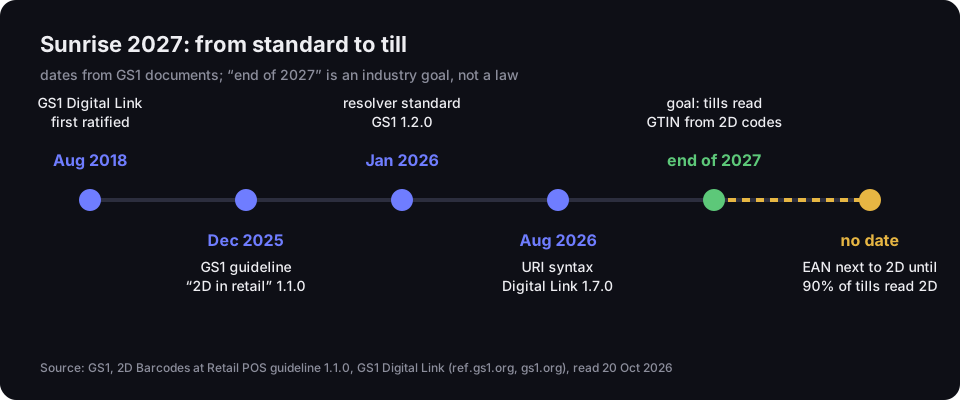
Sunrise 2027: from standard to till
dates from GS1 documents; “end of 2027” is an industry goal, not a law
Source: GS1, 2D Barcodes at Retail POS guideline 1.1.0; GS1 Digital Link (ref.gs1.org, gs1.org), read 20 Oct 2026
Figure description
Timeline. August 2018: GS1 Digital Link first ratified. December 2025: GS1 guideline on 2D barcodes in retail, release 1.1.0. January 2026: GS1-conformant resolver standard 1.2.0. August 2026: GS1 Digital Link URI syntax 1.7.0. End of 2027: goal for tills to read the GTIN from 2D codes. No date: the EAN stays next to the 2D code until 90 percent of tills read 2D.
Will the EAN barcode disappear?
No — under the GS1 guideline the linear barcode stays on pack at least until 90% of tills can read 2D codes (GS1, 2D in Retail 1.1.0). This is the most misquoted part of the topic: search results are full of claims that QR "will replace" the barcode or that shops "must" accept 2D codes from a given date.
The guideline says otherwise. On the threshold: "Until 90% of POS scanning solutions are capable of using GS1 compliant POS 2D barcodes and at minimum capture the GTIN, any products using retail 2D barcodes on-pack will need to be accompanied by a POS linear barcode" (GS1 2D in Retail guideline 1.1.0, read 20 Oct 2026). And more bluntly, from the same document: linear barcodes such as EAN/UPC "will not go away and will coexist with 2D barcodes for as long as there are uses for them."
GS1's FAQ agrees: the original barcode will not disappear entirely by 2027, and both barcodes are expected on packs for some time. The same answer says early adopters are testing QR codes and GS1 DataMatrix in over 45 countries representing about 85% of world GDP (GS1, How long will the transition to 2D barcodes take?, read 19 Oct 2026). Those are figures about trials, not about tills that already read 2D.
GS1 Poland puts it differently: "in the transition period, that is until the end of 2027, both types of codes will coexist on packaging" (GS1 Poland, Barcodes enter a new era, read 20 Oct 2026, our translation), and stresses that it is the brand's decision whether a GS1 QR code appears on its products. The two readings fit together: the EAN stays at least until the end of 2027, and under the global guideline until the 90% threshold is reached. No source gives a date for removing the EAN, so neither do we.
In practice: if you are designing a label today, the EAN-13 stays on it. A 2D code goes next to it, not instead of it.
GS1 Digital Link: the GTIN QR code
GS1 Digital Link puts the GTIN (and other GS1 data) into an ordinary web address, so one QR code works at the till and on a phone. GS1 calls it "the standardised method for encoding identifiers like GS1 GTINs, GLNs and SSCCs, along with batch numbers, serial numbers, expiry dates and more" (GS1, GS1 Digital Link, read 20 Oct 2026). The vision is a single multipurpose 2D barcode used both at the point of sale and by shoppers looking for product information.
The address looks like any other link but has a fixed structure. Take the example GS1 uses in its guideline: https://example.com/01/09506000134352?17=301231 (GS1 2D in Retail guideline 1.1.0, Table 5-2).
- Domain — any. The standard says a GS1 Digital Link URI "can be constructed in any domain name", so it can live on the brand's domain (GS1 Digital Link URI Syntax 1.7.0, ratified August 2026, read 19 Oct 2026).
/01/and the GTIN — 01 is the application identifier (AI) for a GTIN. It is always followed by 14 digits; an EAN-13 gets a leading zero. In the standard's words, GTIN-8, GTIN-12 and GTIN-13 "SHALL be expressed as 14 digits"./10/batch,/21/serial number — optional, but the order is fixed. The standard allows/10/ABC123/21/12345XYZand rejects the reverse.?17=expiry date — optional, YYMMDD, added as a query parameter.
GS1 Poland gives the same rule a reader can check: the GTIN is preceded by 01, for example www.nazwastrony.pl/01/05901234562065. That is the simplest test when you look at a pack: if the scanned address contains /01/ and fourteen digits, it is a GTIN QR code. A plain web address or a short link is an ordinary QR code.
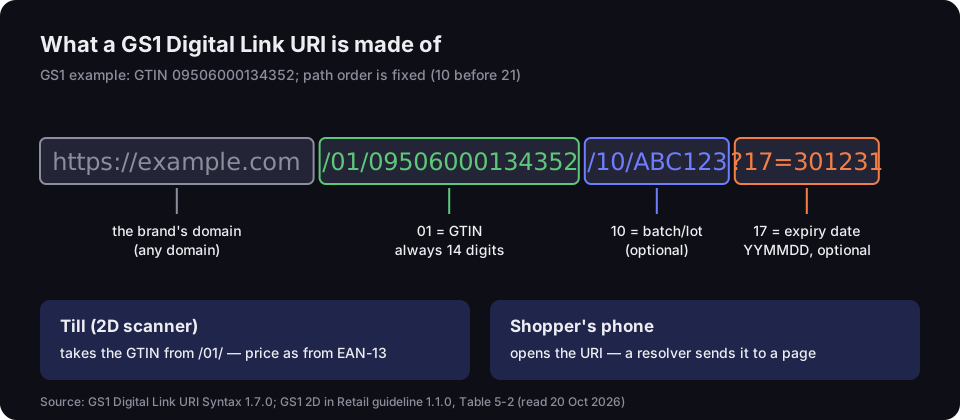
What a GS1 Digital Link URI is made of
GS1 example: GTIN 09506000134352
Source: GS1 Digital Link URI Syntax 1.7.0; GS1 2D in Retail guideline 1.1.0, Table 5-2 (read 20 Oct 2026)
Figure description
The address https://example.com/01/09506000134352/10/ABC123?17=301231 split into parts. https://example.com — the brand's domain, any domain. /01/09506000134352 — application identifier 01 means GTIN, always 14 digits. /10/ABC123 — identifier 10 means batch or lot, optional. ?17=301231 — identifier 17 means expiry date as YYMMDD, optional. A till with a 2D scanner takes the GTIN from the /01/ part and prices it as from an EAN-13. A shopper's phone opens the URI and a resolver sends it to a page.
Resolvers: one code for the till and the shopper
A resolver is the server behind the domain in the URI: it takes the scanned GS1 Digital Link address and sends the phone to the right page. Without one, https://yourbrand.com/01/05901234562065 would simply return a 404, because no page lives at that path. GS1 has a separate standard for GS1-conformant resolvers, at release 1.2.0 from January 2026 at the time of writing (GS1, GS1 Digital Link).
At its simplest, a resolver is a redirect: anything under /01/05901234562065 goes to the product page. A fuller setup sends different link types — instructions, ingredients, certificates — to different pages. GS1 highlights the main benefit: "digital content can be continually updated by a brand owner, without the need to change the QR Code with GS1 Digital Link URI on-pack."
That is how every "dynamic" QR code works: a fixed address in the code, a destination that changes on the server. The difference between a static code and one whose target you can change is covered in our guide on how to make a QR code. What GS1 Digital Link adds is a GTIN inside that fixed address, which the till can read.
The guideline also describes a path for brands that already have an ordinary QR code on pack. Moving from a general URL to one using GS1 Digital Link syntax is "an ideal starting point": a redirect takes whoever scans the code to the same place as before, "but now with the added benefit of being able to be used at retail point-of-sale for price look-up" (GS1 2D in Retail guideline 1.1.0, §5.3.7).
"GS1 QR Code" vs an ordinary QR code: three different things
"GS1 QR code" can mean three different encodings, and only one that carries the GTIN in GS1 format helps at the till. Worth separating before you brief a label designer.
- An ordinary QR code with a web address —
https://yourbrand.com/productor a short link. A phone opens the page; a till cannot pull a GTIN out of it because there isn't one. It is a marketing code, not a product identifier. - A QR code with GS1 Digital Link — an address with
/01/and the GTIN, as above. A phone opens the page via a resolver; a till reads the GTIN. The GS1 specification lists it among the conformant options for general retail: "GS1 DataMatrix, QR Code with GS1 Digital Link URI and Data Matrix with GS1 Digital Link URI are GS1 conformant options" (GS1 General Specifications 26.0, read 19 Oct 2026). - "GS1 QR Code" — a separate variant in the same specification, where GS1 data is encoded as an element string with the FNC1 character rather than as a web address. It is a subset of ISO/IEC 18004 and is not among the retail options quoted above.
For a small brand, the line that matters is between the first and the second. An ordinary QR code to a web page can stay on the pack, but it is not a GTIN QR code and does not move you towards Sunrise 2027.
How much room a GTIN QR code needs on pack
A QR code with a GTIN, a batch and an expiry date fits in about 2 cm at GS1's target module size — as long as you leave out the logo. A QR code's size depends on its number of modules (the small squares), which depends on the length of the address and the error correction level. GS1 sets the module size for a QR code with a GS1 Digital Link URI on retail packaging: minimum 0.396 mm, target 0.495 mm, maximum 0.990 mm, with a quiet zone four modules wide on every side (GS1 General Specifications 26.0, Table 5-46, read 19 Oct 2026). The specification notes that these values reflect a read range typical of mobile phone scanning, and that the URI must be in its uncompressed form.
We calculated the QR version and printed width, quiet zone included, for seven addresses — from a short link to a full URI with GTIN, batch, serial and date. We used the same qrcode library that draws codes in our generator and the GTIN from GS1's example (09506000134352). Formula: width = (modules + 8) × module size. This is our calculation, not a print test.
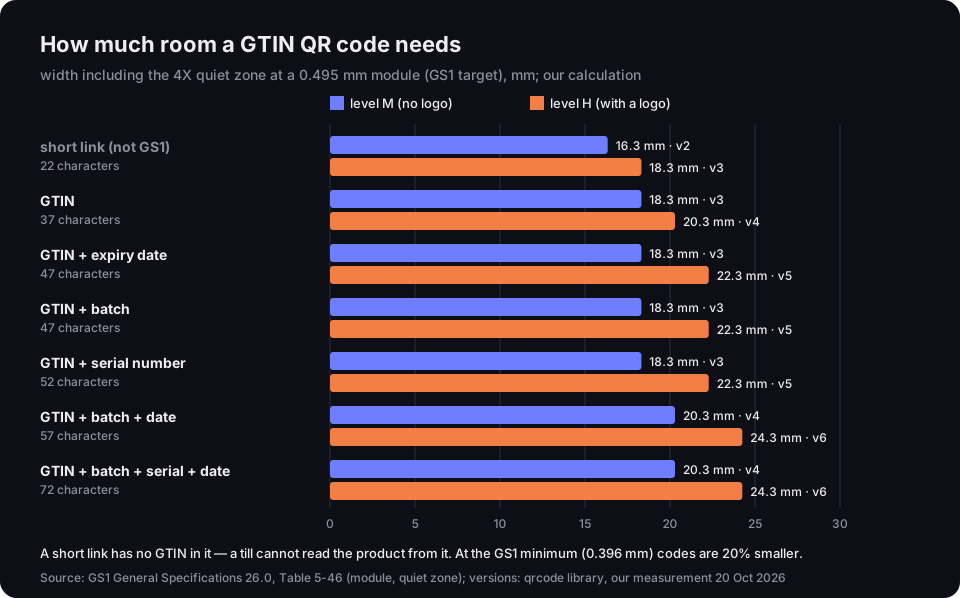
How much room a GTIN QR code needs
width including the 4X quiet zone at a 0.495 mm module, mm; our calculation
Source: GS1 General Specifications 26.0, Table 5-46; code versions: qrcode library, our measurement 20 Oct 2026
Figure description
Bar chart of printed width at a 0.495 mm module, level M without a logo and level H with a logo. Short link, 22 characters: M 16.3 mm, version 2; H 18.3 mm, version 3. GTIN, 37 characters: M 18.3 mm, v3; H 20.3 mm, v4. GTIN and expiry date, 47 characters: M 18.3 mm, v3; H 22.3 mm, v5. GTIN and batch, 47 characters: M 18.3, v3; H 22.3, v5. GTIN and serial number, 52 characters: M 18.3, v3; H 22.3, v5. GTIN, batch and date, 57 characters: M 20.3 mm, v4; H 24.3 mm, v6. GTIN, batch, serial and date, 72 characters: M 20.3, v4; H 24.3, v6. At the GS1 minimum of 0.396 mm the codes are 20 percent smaller.
What this shows:
- GTIN only (
https://example.com/01/09506000134352, 37 characters) is a version 3 code, 29 × 29 modules: 18.3 mm at GS1's target module, 14.7 mm at the minimum. - GTIN plus expiry date, or plus batch (47 characters) still fits version 3 at error correction level M — the same size as the GTIN alone.
- GTIN, batch and date (57 characters) step up to version 4 (33 × 33 modules): 20.3 mm at the target module, 16.2 mm at the minimum. Adding a serial number as well (72 characters) does not change the version.
- A logo in the middle forces the highest error correction level (H), which pushes the version up by one or two steps: the full address with batch and date grows from 20.3 to 24.3 mm. How a logo affects a code is covered in our article on the QR code with a logo.
The version changes in steps, so a few characters' difference in the domain usually doesn't matter — it is the next element of the address that moves the code up a size.
GS1 has one more recommendation that affects size. Ideal 2D barcodes, the guideline says, "have highly contrasting light and dark modules, such as black and white", an even grid of square modules, no cropping and uncompromised error correction. If you modify a code with a logo or colours, GS1 says each such code should be verified to ISO/IEC 15415 (GS1 2D in Retail guideline 1.1.0). For packaging, choose a black-and-white code without a logo. General rules on print size and scanning distance are in our article on why a QR code won't scan.
Digital product passport (ESPR) and the QR code
The EU digital product passport arrives product group by product group, and GS1 Digital Link is one possible way to reach it — not something the regulation requires. The two topics often appear together because both are about a code on the product that leads to data.
The European Commission describes the digital product passport (DPP) as "a digital container for products, components, and materials". Its legal basis is the Ecodesign for Sustainable Products Regulation (ESPR), (EU) 2024/1781 (European Commission, Digital Product Passport, read 20 Oct 2026). The Commission's FAQ is explicit: "there is no general obligation for a product to have a DPP" — it is introduced gradually through product-specific delegated acts (European Commission, DPP FAQ, read 20 Oct 2026).
The Commission's timeline for delegated acts: 2026 — iron and steel; 2027 — textiles, tyres and aluminium; 2028 — furniture; 2029 — mattresses and ICT products. Batteries follow their own track: from 18 February 2027 the passport is mandatory for certain types, including electric vehicle, light means of transport and industrial batteries. After a delegated act is adopted, businesses get a transition period of at least 18 months.
How does the passport connect to a code? The ESPR text says a passport must be connected through a "data carrier" to a persistent unique product identifier, and the data carrier must be physically present on the product, its packaging or accompanying documentation (Article 10(1)). The regulation defines a data carrier as "a linear barcode symbol, a two-dimensional symbol or other automatic identification data capture medium that can be read by a device" (Article 2(29)). Annex III lists, among the data a delegated act may require, the GTIN under ISO/IEC 15459-6 "or equivalent" (Regulation (EU) 2024/1781, English text from the EU Publications Office repository, read 20 Oct 2026).
So the regulation names neither QR codes nor GS1 Digital Link. Which data carriers apply to a product group is set by that group's delegated act (Article 9(2)(b)). A QR code with GS1 Digital Link may be one of them, but that depends on the act for your sector. If you sell textiles, furniture or electronics, keep an eye on the delegated acts for your group.
What a small brand should do now
The sensible order for a small business: keep the GTIN, keep the EAN, and add a QR code in GS1 Digital Link syntax at your next label change — then test the print. Four steps:
- Your GTIN from your GS1 member organisation stays the foundation. The same number sits under the EAN-13 bars and in the
/01/part of the GTIN QR code. No GTIN, no GS1 code — if you don't have one yet, start with our article on the EAN code. - The EAN-13 stays on pack for the whole transition — when that ends is covered under “Will the EAN barcode disappear?”. The 2D code goes next to it.
- If you add a QR code, encode a GS1 Digital Link URI on the brand's domain and set up a redirect from that path to the product page (or use a resolver). If you already have an ordinary QR code to a web page, this is exactly the transition GS1 calls a good starting point.
- Do a test print and verify the code. Scan it with several phones, check the address contains
/01/and the right GTIN, and that the redirect works. If the code has a logo or colours, GS1 recommends verification to ISO/IEC 15415.
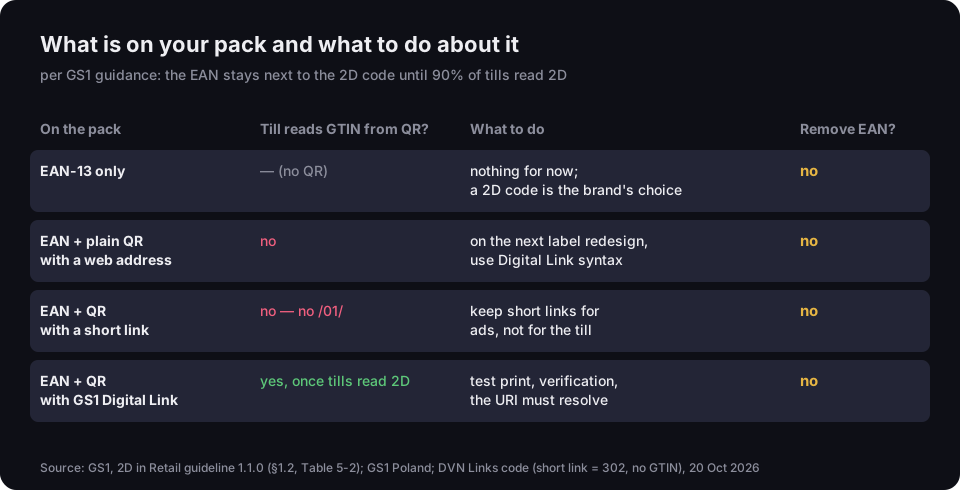
What is on your pack and what to do about it
per GS1 guidance: the EAN stays next to the 2D code until 90% of tills read 2D
Source: GS1, 2D in Retail guideline 1.1.0 (§1.2, Table 5-2); GS1 Poland; DVN Links code, 20 Oct 2026
Figure description
Table of four situations. EAN-13 only: no QR code; nothing for now, a 2D code is the brand's choice; keep the EAN. EAN plus a plain QR code with a web address: the till cannot read a GTIN from the QR code; at the next label redesign use Digital Link syntax; keep the EAN. EAN plus a QR code with a short link: the till cannot read a GTIN because there is no /01/ in the address; keep short links for ads, not for the till; keep the EAN. EAN plus a QR code with GS1 Digital Link: the till reads the GTIN once it reads 2D codes; test print, verification, the URI must resolve; keep the EAN.
What not to do: don't remove the EAN because the 2D code "is already there". Don't print a short link and call it a GS1 QR code — it has no /01/ and no GTIN. Don't swap the order: /10/ comes before /21/.
How DVN Links helps, and what it won't do. Our barcode generator draws an EAN-13 from your number and checks the check digit; the PNG download is free and needs no account. Print-ready SVG and PDF files with dimensions in millimetres come with paid plans from Starter (pricing, prices excl. VAT). Which file to send the printer is covered in QR code SVG, PDF or PNG. The URL type in our QR code generator encodes a GS1 Digital Link URI as an ordinary static code — exactly as you type it.
The limits, honestly. The QR generator does not validate GS1 Digital Link syntax or the GTIN check digit in the address — a typo goes through without a warning, so a test print is a must. We do not run a GS1 resolver; the redirect from /01/… is set up on your server. The generator does not draw GS1 DataMatrix or the FNC1-based "GS1 QR Code". A DVN short link (for example dvn.dev/abc123) is not a GS1 Digital Link URI, and a till cannot read a product from it. And on the Free plan, the generator adds the DVN logo and a dvnlinks.pl caption to every QR code, and a code with a logo is encoded at level H. For packaging, a plain black-and-white code is better — paid plans from Starter drop the DVN logo.
Frequently asked questions
Not any time soon. Under the GS1 guideline, a product with a 2D code needs a linear barcode next to it until 90% of tills read 2D, and EAN/UPC barcodes "will not go away". GS1 Poland says both codes will coexist on packaging during the transition period, until the end of 2027. Whether to add a QR code is the brand's decision.
A web address whose path carries the GTIN — after /01/, always 14 digits — and optionally a batch, serial number or expiry date. A till with a 2D scanner reads the GTIN from it like a barcode; a phone opens it like any link, usually via a resolver on the brand's domain.
You need a GTIN from GS1 and a GS1 Digital Link URI on your domain that redirects to a product page. Any QR code generator can encode that address, including our URL type, but no ordinary generator checks the syntax for you — validate it and run a test print before the full print run.
For a product information page, yes — a phone will open it. For the till, no: there is no /01/ and no GTIN in the address. Short links are useful on posters and in ads where you count scans; a pack that should work at the till needs a GS1 Digital Link URI.
Only if the delegated act for your product group requires one. The European Commission says there is no general obligation: the passport arrives product by product, and once an act is adopted businesses get at least 18 months to comply. A full list of what our tools do is on the features page.