EAN code: what it is, where to get one and how to print it
An EAN code's number comes from GS1; the barcode you can draw yourself. What a 590 prefix means, how to work out the check digit and how much room the barcode takes.
An EAN code is the thirteen digits under the bars on a pack — more precisely, the GTIN number those bars encode. The two names blur two things worth keeping apart. The number is assigned by GS1, through the member organisation in your country, and cannot be "generated". The barcode is only a picture of that number, which any generator can draw, including our barcode generator. GS1 Poland puts it in a few words: "EAN is the bars, GTIN the digits" (GS1 Poland, Order a GTIN, read 19 Oct 2026, our translation). Below: what the number is made of, what the prefix says, how to work out the check digit, where to get a number and how much room the barcode needs — measured on files from our generator.
EAN code vs GTIN: what each name means
EAN is the name of the barcode symbol; GTIN is the name of the number the symbol carries. GS1 defines the GTIN (Global Trade Item Number) as a number a company "can use to uniquely identify all of its trade items" (GS1, GTIN, read 19 Oct 2026), and a trade item as a product or service that is priced, ordered or invoiced anywhere in the supply chain.
A GTIN comes in four lengths: 8, 12, 13 or 14 digits. Google describes it the same way in its product data specification, where the gtin field accepts those lengths for "UPC, EAN, JAN, or ISBN" numbers (Google Merchant Center, GTIN, read 19 Oct 2026). Each length has its own barcode:
|
Number |
Barcode |
Where you see it |
|---|---|---|
|
GTIN-13 |
EAN-13 |
most retail products outside North America |
|
GTIN-8 |
EAN-8 |
small packs with no room for an EAN-13 |
|
GTIN-12 |
UPC-A |
products for the US and Canadian market |
|
GTIN-14 |
ITF-14 |
outer cartons and cases — usually scanned in the warehouse, not at the till |
The descriptions follow GS1 Poland's pages on EAN/UPC and ITF-14 barcodes (read 19 Oct 2026). "The EAN code of the product" almost always means a GTIN-13 and the EAN-13 barcode that carries it.
"EAN-128" usually means GS1-128, a barcode that adds data such as a best-before date or batch number using GS1 Application Identifiers (GS1 Poland, GS1-128). Our generator draws both: plain Code 128 for internal labels and GS1-128 with Application Identifiers.
What an EAN-13 number is made of
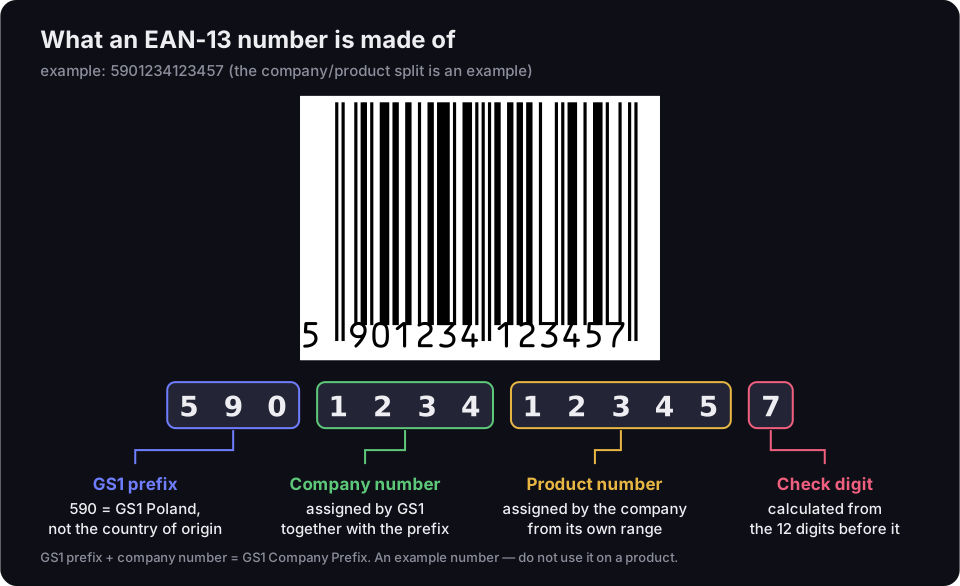
An EAN-13 number is a GS1 prefix, a company number, a product number and a check digit. Take the example our generator also shows: 5901234123457. Like every number in this piece, it is an example — don't print it on your product. GS1 even reserves prefix 952, "used for demonstrations and examples of the GS1 system" (GS1, Company Prefix); we stay with 590 because the next section is about it.
What an EAN-13 number is made of
example number 5901234123457; the company/product split is an example
Source: GS1, GS1 Company Prefix (read 19 Oct 2026); barcode drawn with our generator, 19 Oct 2026
Figure description
An EAN-13 barcode for the number 5901234123457 and its parts. 590 — the GS1 prefix, here GS1 Poland, not the country of origin. 1234 — the company number, assigned by GS1 together with the prefix. 12345 — the product number, assigned by the company from its own range. 7 — the check digit, calculated from the twelve digits before it. The prefix and the company number together form the GS1 Company Prefix. An example number, not for use on a product.
The first three digits are the GS1 prefix — the number of the member organisation that issued the numbers. Together with the digits that follow, they form the GS1 Company Prefix. Nothing starts without it: "Before you can begin using GS1 identification keys and barcodes, you need a GS1 Company Prefix" (GS1, Company Prefix, read 19 Oct 2026). The "1234 / 12345" split in the figure is only an example — in your number the boundary between company and product may sit elsewhere. Then comes the product number, which you assign from your range, and finally the check digit, which carries no information but lets software catch a typo.
One product, one number — and "product" is meant narrowly. GS1 Poland writes that every feature that tells one product from another, such as colour, flavour, size or the way it is packed, needs its own number (GS1 Poland, Order a GTIN). Google says the same about variants: each product and each variant in a different colour or size has its own GTIN (Google Merchant Center). Five flavours of the same juice means five numbers.
Does the barcode prefix show the country of origin?
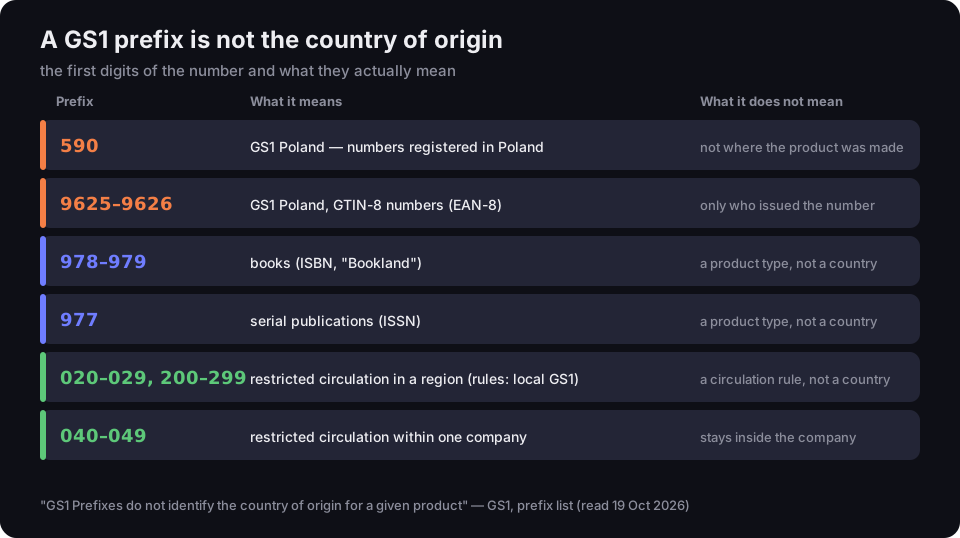
No — a prefix such as 590 tells you which GS1 organisation issued the number, not where the product was made. It is one of the most common myths about barcodes, and GS1 answers it directly: companies can make their products anywhere in the world, so "GS1 Prefixes do not identify the country of origin for a given product" (GS1, Company Prefix, read 19 Oct 2026).
A GS1 prefix is not the country of origin
the first digits of the number and what they actually mean
Source: GS1, list of GS1 prefixes (read 19 Oct 2026)
Figure description
A table of GS1 prefixes. 590: GS1 Poland — numbers registered in Poland, not where the product was made. 9625–9626: GS1 Poland, GTIN-8 numbers for the EAN-8 barcode — again only who issued the number. 978–979: books (ISBN, Bookland) — a product type, not a country. 977: serial publications (ISSN) — a product type, not a country. 020–029 and 200–299: restricted circulation within a region, with rules set by the local GS1 organisation — a circulation rule, not a country. 040–049: restricted circulation within one company, the number stays inside the company.
On the GS1 list, 590 simply says "GS1 Poland": the organisation through which the company registered its numbers. A Polish company manufacturing in Asia prints 590; a brand registered elsewhere can produce in Poland with a different prefix. The country of manufacture is on the label, not in the barcode.
Some prefixes have nothing to do with countries at all. 978–979 are books (the GS1 list calls them "Bookland (ISBN)"), 977 is serial publications with an ISSN. The ranges 020–029 and 200–299 are for restricted circulation within a region, under rules set by the local GS1 organisation, and 040–049 for numbers used only inside one company. For 8-digit numbers GS1 Poland has its own prefixes, 9625 and 9626 — "assigned to GS1 Poland for GTIN-8 allocation" (ibid.).
How to calculate the EAN check digit
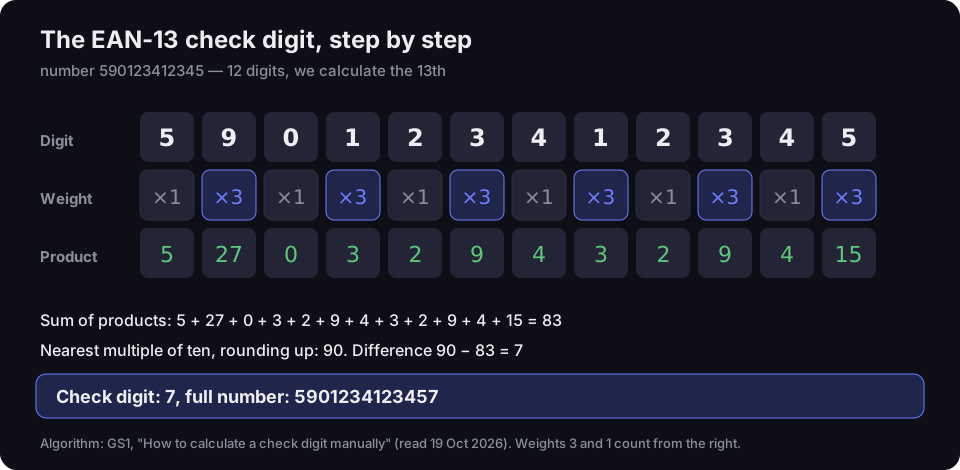
The check digit is one digit worked out from the twelve before it; mistype one digit and the result no longer matches, so the system rejects the number. GS1's method has three steps: multiply the digits alternately by 3 and 1, add the results, and subtract the sum from the nearest equal or higher multiple of ten — the difference is the check digit (GS1, How to calculate a check digit manually, read 19 Oct 2026). The weights count from the right: the digit just before the check digit gets ×3, the one before it ×1, and so on. In an EAN-13 that means, reading from the left, the first digit has weight 1, the second 3, the third 1. The same algorithm gives the check digit of an 18-digit SSCC on a pallet.
The EAN-13 check digit, step by step
number 590123412345 — 12 digits, we calculate the 13th
Source: GS1 algorithm (read 19 Oct 2026); our calculation, checked with the DVN Links generator's function, 19 Oct 2026
Figure description
Working out the check digit for 590123412345. The digits 5 9 0 1 2 3 4 1 2 3 4 5 are multiplied by the weights 1 3 1 3 1 3 1 3 1 3 1 3. Products: 5, 27, 0, 3, 2, 9, 4, 3, 2, 9, 4, 15. The sum is 83. The nearest multiple of ten rounding up is 90; 90 minus 83 is 7. Check digit 7, full number 5901234123457.
In our example the products add up to 83 and the next multiple of ten is 90, so the check digit is 7. If the sum is already round, say 80, the check digit is 0. The same method works for EAN-8, UPC-A and ITF-14.
You don't have to do it by hand. Type 12 digits into our generator and it adds the thirteenth, with the message "Check digit added: 7." Type 13 digits with a mistake and it replies "The check digit does not match — it should be 7. Check the number for a typo." That is how the live generator answers 5901234123459 (our check, 18 Oct 2026). GS1 Poland also has its own check digit calculator.
One caveat that matters in the next section: a valid check digit only means the number is well formed. It does not mean anyone ever assigned it.
Where to get an EAN code for your product
For sale in shops and on marketplaces, the number comes from your country's GS1 organisation, as a range under your company prefix. GS1 Poland calls GS1 "the only official source of GTIN numbers in the world" (GS1 Poland, Order a GTIN, read 19 Oct 2026, our translation). Fees and paperwork differ by country; in Poland the steps are:
- Count your products. Every product and variant (colour, flavour, size, pack) needs its own number; the count decides the range.
- Apply. GS1 Poland says registration takes up to 3 working days from the application and payment (ibid.).
- Pay the membership. An annual fee and, in some cases, a one-off registration fee, depending on revenue and range size — see your GS1 organisation's price list. The annual fee recurs every 12 months, and GS1 Poland states that without it you can't use the numbers or sell in retail chains and on marketplaces.
- Assign numbers to each variant and keep a list.
- Draw the barcodes with any generator — GS1 Poland's members also get its MojeGS1 platform for this — or with ours (below).
Marketplaces check where numbers come from. GS1 Poland issues members a certificate that "confirms the authenticity of GTIN numbers (EAN codes)" and adds that "platforms such as Allegro or Amazon may require it" (ibid., our translation). We haven't checked the current rules of every platform, so read the help pages of the one you sell on before listing a product.
Small product, small barcode. If an EAN-13 doesn't fit on the pack, GS1 Poland assigns an 8-digit number for an EAN-8 — but only when the printable area is no larger than 40 cm², or a round pack has a diameter of up to 3 cm. You send a photo and the dimensions so GS1 can rule out an EAN-13 (GS1 Poland, Order a GTIN). Rules in other countries may differ; ask your GS1 organisation.
Second-hand numbers. Some companies resell single EAN numbers. We don't name them, but such a number comes from the prefix of whoever registered it with GS1, not from yours — and it won't replace a GS1 membership certificate in your company's name if a platform asks for one. GS1 Poland's code and product search lets you look a number up.
Internal numbers. For a barcode used only in your warehouse or on staff badges, you don't need a GTIN: your own number in Code 128 or Code 39 will do.
Pallet numbers. The same prefix gives you SSCCs for pallets and outer cases — how, and how many your pool allows, is in our article on the SSCC barcode.
Can you generate an EAN code number?
No — a generator can calculate the check digit and draw the barcode, but it can't assign the number. Twelve random digits plus a correct check digit pass every format check, yet the number belongs either to no one or to another company's product.
Google leaves no room for doubt. Its Merchant Center requirements say: "Only provide a GTIN if you're sure it's correct. When in doubt don't provide a GTIN (for example, don't guess or make up a value)" (Google Merchant Center, GTIN, read 19 Oct 2026). The same page notes that products with a missing or incorrect GTIN may have limited visibility, and that without a GTIN Google can't guarantee matching the offer to the right product.
Hence a simple rule:
- You sell in shops, retail chains, on Amazon or Allegro, in Google Shopping — get the number from GS1. The generator only draws the barcode.
- The barcode is only for you — stock, stocktaking, order labels — use your own number in Code 128 or Code 39, without dressing it up as a GTIN.
- The product has no GTIN and doesn't need one (say, handmade goods sold directly) — Merchant Center lets you leave the GTIN out rather than invent one (ibid.).
Our generator follows the same rule and says so under the form: "The generator draws a code from the number you type — it does not issue numbers. EAN numbers for retail products are issued by GS1."
How to make a print-ready EAN barcode
Once you have a number from GS1, the barcode takes a minute: choose the symbol, type the number, download the file. In our barcode generator it goes like this:
- Choose the barcode type. There are seven: EAN-13, EAN-8, UPC-A, ITF-14, Code 128, Code 39 and GS1-128. For a GTIN-13 choose EAN-13.
- Type the number. Enter 12 digits and the generator adds the check digit; enter all 13 and it checks it. Spaces and hyphens (
590 1234 12345 7) are ignored. - Download the file. PNG is free and needs no account. Vector files for print — SVG and PDF — come with the paid plans from Starter, and making many barcodes at once (up to 100 numbers in one PDF or one ZIP of SVG files) from the Pro plan. Details and prices are on the pricing page.
Use a vector file for print: a PNG blurs when enlarged, and in a barcode the exact width of bars and gaps is what counts. SVG and PDF scale without loss. What is inside these files, and why the size in mm matters here, is covered in QR code SVG, PDF or PNG.
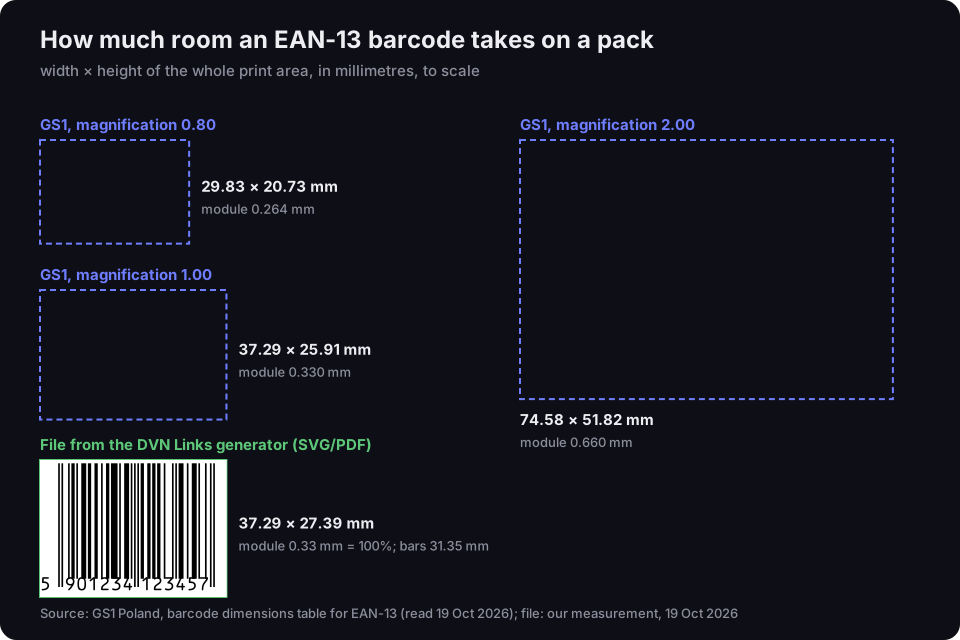
How much room to leave? GS1 Poland gives EAN-13 dimensions for the whole print area, margins included: at nominal size (magnification 1.00, module — the narrowest bar — 0.330 mm) the barcode takes 37.29 × 25.91 mm. It can shrink to 0.80 (29.83 × 20.73 mm) or grow to 2.00 (74.58 × 51.82 mm); the size "can vary smoothly from 0.80 to 2.00" of nominal (GS1 Poland, 1D barcode dimensions, read 19 Oct 2026, our translation).
How much room an EAN-13 barcode takes on a pack
width × height of the whole print area, in millimetres, to scale
Source: GS1 Poland, 1D barcode dimensions, EAN-13 table (read 19 Oct 2026); file: our measurement, 19 Oct 2026
Figure description
Rectangles to scale comparing EAN-13 dimensions. According to GS1 Poland, at magnification 0.80 with a 0.264 mm module the barcode takes 29.83 by 20.73 mm, at 1.00 with a 0.330 mm module 37.29 by 25.91 mm, at 2.00 with a 0.660 mm module 74.58 by 51.82 mm. The SVG or PDF file from the DVN Links generator has a 0.33 mm module, that is 100 percent nominal size, bars 31.35 mm wide and a whole file of 37.29 by 27.39 mm — the same width as the GS1 area.
We measured our generator's files (19 Oct 2026). The EAN-13 for 5901234123457 has a 0.33 mm module, which matches nominal size (1.00). The bars are 31.35 mm wide; the whole file is 37.29 × 27.39 mm. The width matches the GS1 table exactly: the left margin is 3.63 mm (11 modules, holding the first digit of the number), the right one 2.31 mm (7 modules). The height is just under 1.5 mm more than in the table because the bars in the file are slightly taller. Leave at least that much room on the pack, don't scale below 0.80, and on poor surfaces scale up rather than down — GS1 Poland notes that better print and surfaces allow smaller barcodes (ibid.).
Three print rules that get broken most often:
- A clear margin. The scanner uses the light area on both sides to find the barcode. The file includes it; don't crop it or push the barcode into a fold — the same rule as for QR codes in our piece on minimum print size.
- Dark bars on light. Keep the black on white; test any other colours on a proof.
- A test print. Scan a proof at final size. A phone app checks the number; for a formal quality grade, GS1 Poland offers barcode verification.
EAN-13, EAN-8, UPC-A, ITF-14, Code 128: which one when
The symbol follows from the number and from where the barcode will be scanned; for a retail product outside North America the answer is almost always EAN-13. The others have their niches. How barcodes work in the first place, and how they differ from 2D codes, is covered in our guide what is a barcode, and Code 128, Code 39 and GS1-128 are compared in our piece on EAN 128 and Code 128.
|
Barcode |
What it carries |
When |
|---|---|---|
|
EAN-13 |
GTIN-13 (13 digits) |
a product sold in a shop or on a marketplace |
|
EAN-8 |
GTIN-8 (8 digits) |
a small pack, once GS1 has assigned an 8-digit number |
|
UPC-A |
GTIN-12 (12 digits) |
a product for the US and Canadian market |
|
ITF-14 |
GTIN-14 (14 digits) |
an outer carton or shipping case — usually scanned in the warehouse |
|
Code 128 |
any text: unaccented letters, digits, symbols |
order numbers, warehouse labels, internal codes — no meaning in retail |
|
Code 39 |
capital letters, digits, space and |
badges, industrial marking; the generator turns lower case into capitals |
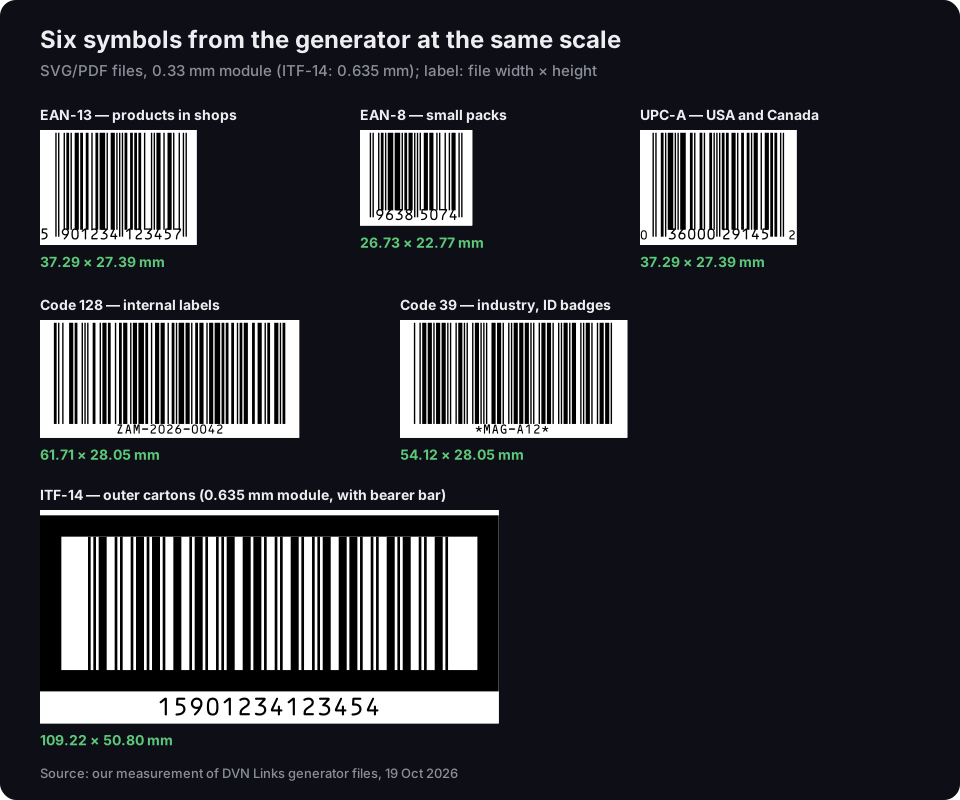
Six symbols from the generator at the same scale
SVG/PDF files, 0.33 mm module (ITF-14: 0.635 mm); label: file width × height
Source: our measurement of DVN Links generator files, 19 Oct 2026
Figure description
Six barcodes from the DVN Links generator drawn at the same scale. EAN-13 for 5901234123457: file 37.29 by 27.39 mm. EAN-8 for 96385074: 26.73 by 22.77 mm. UPC-A for 036000291452: 37.29 by 27.39 mm. Code 128 for the text ZAM-2026-0042: 61.71 by 28.05 mm. Code 39 for MAG-A12: 54.12 by 28.05 mm — these five at a 0.33 mm module. ITF-14 for 15901234123454, at a 0.635 mm module with a bearer bar around the code: 109.22 by 50.80 mm.
The figure shows why EAN-8 exists: at the same module it is more than 10 mm narrower and almost 5 mm lower than an EAN-13 (26.73 × 22.77 against 37.29 × 27.39 mm in our files). It also shows the price of Code 128 and Code 39's flexibility: a barcode with 7–13 characters of text is much wider than an EAN-13 with thirteen digits (61.71 and 54.12 mm), because each character takes more room than a digit does in an EAN.
ITF-14 has its own dimensions, because it is printed on cartons, often straight onto board. In GS1 Poland's table for general distribution the narrow bar is 0.508 to 1.016 mm (magnification 0.5–1.0; GS1 recommends not going above 1.0), the bars are at least 32 mm high, the clear margin is ten times the narrow bar, and around the barcode runs a bearer bar 4.8 mm thick (GS1 Poland, 1D barcode dimensions). The ITF-14 file from our generator has a 0.635 mm narrow bar (magnification 0.625), bars 32.38 mm high and a bearer bar around the code — 109.22 × 50.80 mm in all (our measurement, 19 Oct 2026). At any other magnification, check the dimensions with your printer.
Barcodes and QR codes: what is changing in retail
Retail is moving to two-dimensional codes, but the GTIN stays — only the symbol that carries it changes. GS1 US describes Sunrise 2027 as a transition from 1D barcodes "to 2D barcodes, like QR codes", meant to make sure point-of-sale systems "can read and process these next-generation data-packed codes" and that brands can share more information with consumers (GS1 US, Sunrise 2027, read 19 Oct 2026). GS1 Poland writes about the "QR code from GS1": a code that identifies the product at the till like an EAN does and, scanned with a phone, opens a page with information about it (GS1 Poland, Barcodes enter a new era).
The GTIN stays the foundation, inside both the barcode and the GS1 QR code, so there's no reason to wait with EAN-13. An ordinary QR code with a link to the product page — the kind we cover in our guide to making a QR code — doesn't carry a GTIN, so it won't replace the EAN at the till. What Sunrise 2027 actually involves and how much room a GTIN QR code needs is covered in a separate article.
Frequently asked questions
The barcode costs nothing — our PNG is free. You pay GS1 for the number: an annual fee and sometimes a registration fee, depending on revenue, range and country.
It depends on the platform and the category. Google Merchant Center asks for a GTIN when the product has one and forbids making one up. GS1 Poland writes that platforms such as Allegro or Amazon may require a certificate confirming the numbers. Check your platform's rules for your category before listing.
An ISBN is a book number. On the GS1 list the prefixes 978 and 979 are reserved for books ("Bookland (ISBN)"), so an ISBN in a barcode is a 13-digit number starting with 978 or 979 and looks on the cover like an ordinary EAN-13.
That the number was issued by GS1 Poland — the company registered its numbers in Poland. It doesn't mean the product was made in Poland: GS1 states plainly that prefixes don't identify the country of origin.
No. A GTIN identifies one specific product of one specific company. With someone else's number, your product will look like theirs in shop and marketplace systems — and Google explicitly forbids guessing or making up numbers.
When the product is genuinely small: according to GS1 Poland, when the printable area is no more than 40 cm² or a round pack is up to 3 cm in diameter. GS1 Poland assigns the GTIN-8 separately, after you send a photo and the product's dimensions.
Already have a number from GS1? Type it into the barcode generator — we'll check the check digit for you, and the PNG downloads without an account.