SSCC barcode: the 18-digit pallet number, explained
An SSCC barcode carries an 18-digit pallet number in GS1-128. How it is built, how many numbers your GS1 prefix gives you, the check digit and the label rules.
An SSCC barcode is a GS1-128 barcode that carries an SSCC — a Serial Shipping Container Code, the 18-digit number of one specific pallet, case or parcel — behind the Application Identifier (00). The SSCC is the only mandatory element of a GS1 logistic label. Nobody hands you a number for each pallet: you build it yourself from your company's GS1 prefix. Below: what the 18 digits are made of, how many numbers your prefix gives you, how to calculate the check digit using the worked example from the GS1 standard, when a number may be reused, and what a pallet label must contain. At the end, a measurement: how much room an SSCC barcode from our barcode generator takes on an A6 label. For what a barcode is in general, and the main types, see our guide what is a barcode.
What is an SSCC, and how it differs from a GTIN
A GTIN tells you what the product is; an SSCC tells you which pallet this is. Every bag of the same coffee carries the same GTIN (printed as an EAN-13 barcode). Every pallet, even one stacked with identical coffee, carries a different SSCC. In GS1's words: "The SSCC is the only GS1 key that SHALL be used as the identifier of a logistic unit. The SSCC ensures that logistic units are identified with a number that is unique worldwide" (GS1 General Specifications, Release 26.0, §2.2, read 21 Oct 2026). A logistic unit is anything you put together for transport or storage and want to track on its own: a pallet, an outer case, a courier parcel, a container.
A pallet can carry both numbers. If it holds a single product and the brand owner treats it as a trade item, GS1 allows a GTIN as well — but not instead of the SSCC: "The combination of a GTIN and a serial number SHALL NOT replace the SSCC as the identifier of a logistic unit" (ibid., §2.2). That is why pallet labels often have two barcodes: one with the SSCC, another with the GTIN of the goods inside and the item count.
Why a separate number? Because the SSCC is the key to data that travels separately, in an EDI despatch advice (more on that at the end). The receiving warehouse scans the pallet and knows what is inside without cutting the wrap.
GTINs, the GS1 prefix and where to get numbers for your products are covered in our article on the EAN number. This one is about the pallet number.
SSCC structure: what the 18 digits mean
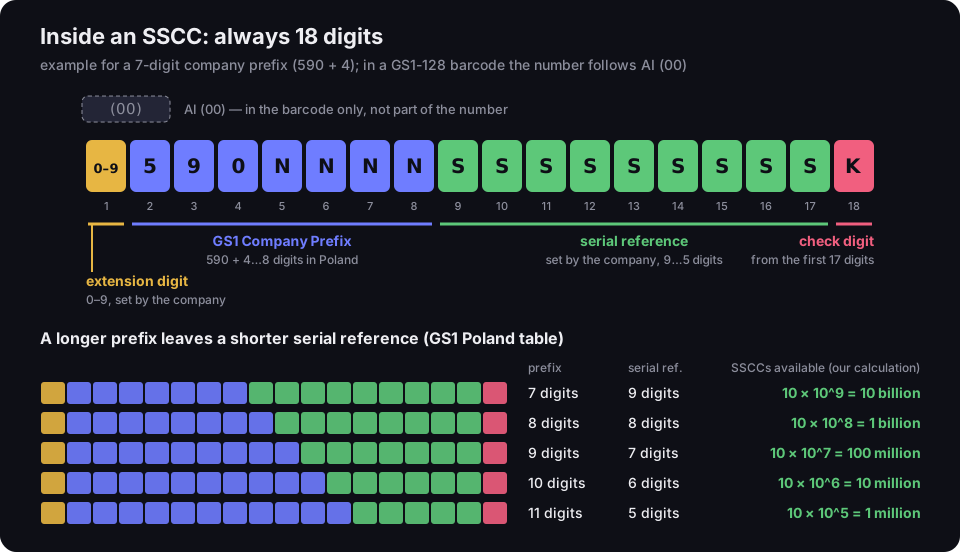
An SSCC is always 18 digits: an extension digit, the GS1 Company Prefix, a serial reference and a check digit. GS1 describes SSCCs as "unique fixed length 18-digit strings as they incorporate an extension digit, a GS1 Company Prefix with a serial reference and […] a final check digit" (GS1 General Specifications R26.0, §1.3.5).
Inside an SSCC: always 18 digits
example for a 7-digit company prefix; below, the five prefix lengths from the GS1 Poland table
Source: GS1 General Specifications R26.0, §1.3.5 and §3.3.1; GS1 Poland, SSCC structure, read 21 Oct 2026; counts — our calculation
Figure description
Diagram of the 18 positions of an SSCC. Above them the Application Identifier 00, which appears only in the barcode and is not part of the number. Position 1: extension digit, 0 to 9, set by the company. Positions 2 to 8: GS1 Company Prefix, in Poland 590 followed by 4 to 8 digits. Positions 9 to 17: serial reference, set by the company, 9 to 5 digits. Position 18: check digit calculated from the first 17. Below, five variants: a 7-digit prefix with a 9-digit serial reference gives 10 times 10 to the power of 9, or 10 billion numbers; an 8-digit prefix gives 1 billion; 9 digits, 100 million; 10 digits, 10 million; an 11-digit prefix with a 5-digit serial reference gives 1 million numbers.
- Extension digit (1 digit). You choose it, 0 to 9. GS1: "The extension digit is used to increase the capacity of the serial reference within the SSCC. It is assigned by the company that constructs the SSCC. The extension digit ranges from 0-9" (ibid., §3.3.1). It carries no hidden meaning; it is simply one more digit that multiplies your numbers by ten.
- GS1 Company Prefix. The same prefix you use for GTINs. GS1 Company Prefixes are four to twelve digits long (ibid., §1.2.3.3); in Poland a prefix is 590 followed by 4 to 8 digits (GS1 Poland, SSCC, read 21 Oct 2026), which is the example on the diagram.
- Serial reference. It takes whatever is left: the longer the prefix, the shorter the serial reference. How you build it is up to you — GS1 says its structure is "at the discretion of owner of the GS1 Company Prefix to uniquely identify each logistic unit" (GS1 General Specifications R26.0, §3.3.1). The simplest option is a counter that goes up by one with every pallet.
- Check digit (1 digit). Calculated from the first 17 digits; it catches typos and misreads (see below).
Two traps. First, the prefix says nothing about where the pallet came from. GS1 says the prefix "makes the SSCC unique worldwide but does not identify the origin of the unit" (ibid., §3.3.1) — it only tells you which GS1 organisation issued the prefix to the company that numbered the pallet. Second, (00) is not part of the number. In the barcode and in the text under it you see (00) plus 18 digits, 20 digits in total — which is why some pages claim an SSCC "has 20 digits". It does not: the first two are the AI. Store 18 digits in your system; on the label, GS1 recommends the data title "SSCC" next to the human-readable number (ibid.).
Where does the prefix come from? From joining GS1 in your country, exactly as for EAN numbers — the process is described in our EAN number article. If your company has a GS1 Company Prefix for its GTINs, the same prefix gives you SSCCs. A single GTIN licensed on its own (some GS1 organisations sell them) comes without a prefix, so it does not.
How many SSCC numbers your GS1 prefix gives you
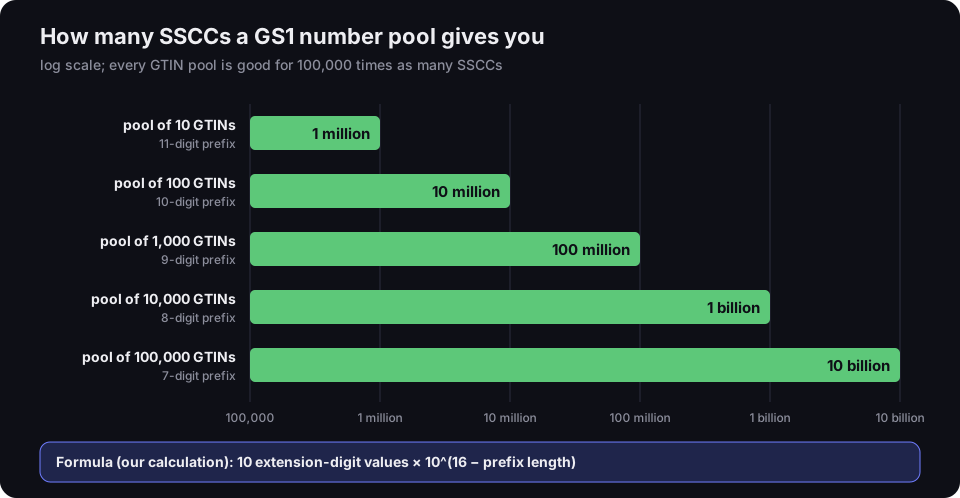
Every pool of GTINs is worth 100,000 times as many SSCCs — from 1 million SSCCs for a pool of 10 GTINs to 10 billion for a pool of 100,000. Those figures come from GS1 Poland's page on the logistic label: a pool of 10 GTINs gives 1 million SSCCs, 100 gives 10 million, 1,000 gives 100 million, 10,000 gives 1 billion and 100,000 gives 10 billion (GS1 Poland, GS1 logistic label, read 21 Oct 2026).
Where do they come from? We derived them from the structure of the number, and the result matches GS1 Poland's table. Of the 18 digits, two have fixed roles (extension and check digit); the prefix and the serial reference share the rest. The count is 10 extension-digit values × 10^(16 − prefix length). A 7-digit prefix leaves 9 digits of serial reference: 10 × 10⁹ = 10 billion. An 11-digit prefix leaves 5: 10 × 10⁵ = 1 million. The same prefix in a GTIN-13 (12 digits before the check digit) leaves five digits fewer for item references than an SSCC leaves for serials — hence the constant ratio of 100,000.
How many SSCCs a GS1 number pool gives you
log scale; GTIN pool and the matching prefix length
Source: GS1 Poland, GS1 logistic label, read 21 Oct 2026; formula and prefix lengths — our calculation from GS1 General Specifications R26.0, §3.3.1
Figure description
Bar chart on a logarithmic scale. Pool of 10 GTINs, 11-digit prefix: 1 million SSCCs. Pool of 100 GTINs, 10-digit prefix: 10 million. Pool of 1,000 GTINs, 9-digit prefix: 100 million. Pool of 10,000 GTINs, 8-digit prefix: 1 billion. Pool of 100,000 GTINs, 7-digit prefix: 10 billion. Formula, our calculation: 10 extension-digit values times 10 to the power of 16 minus the prefix length.
Even the smallest pool lasts a long time: a million numbers at 100 pallets a day is over 27 years of shipments (our calculation), and numbers may be reused. The hard part is different: never giving two pallets the same number. If several workstations or warehouses print labels, split the range between them — for example extension digit 1 for warehouse A and 2 for warehouse B. That split is our suggestion, not a GS1 rule; the standard leaves the serial structure to you.
SSCC check digit: how to calculate it
You calculate the check digit from the first 17 digits: multiply them alternately by 3 and 1 starting from the right, add up, and top the sum up to the next multiple of 10. GS1 uses one algorithm for all its fixed-length numbers: "This algorithm is identical for all fixed length numeric GS1 data structures" (GS1 General Specifications R26.0, §7.9.1). It is the same one that produces the EAN-13 check digit, also shown in our EAN number article.
The standard gives a worked example for 18 digits: 37610425002123456 (ibid., Table 7-9). We recalculated it with the same function our generator uses:
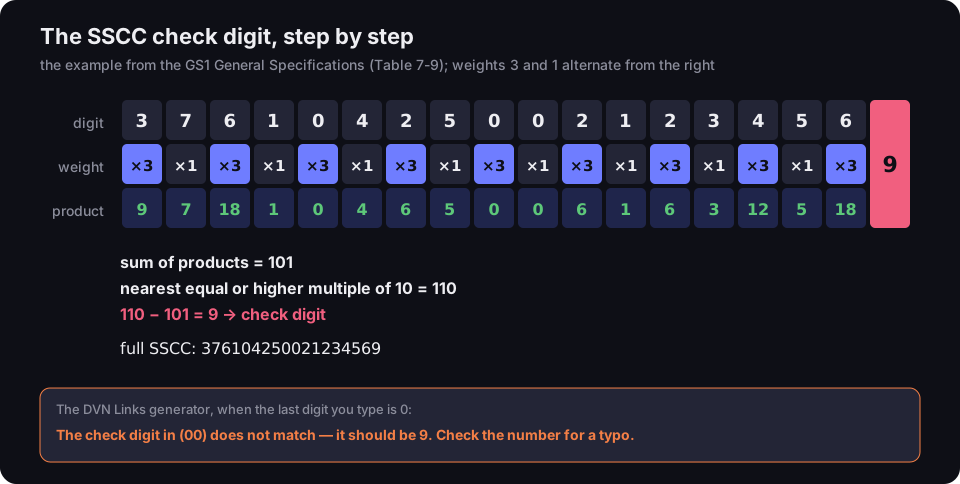
- Weights. The last of the 17 digits (6) gets weight 3, the one before it (5) gets 1, the next (4) gets 3, and so on back to the first digit. With 17 digits, the first one also gets weight 3.
- Products and sum. 3×3 + 7×1 + 6×3 + 1×1 + 0×3 + 4×1 + 2×3 + 5×1 + 0×3 + 0×1 + 2×3 + 1×1 + 2×3 + 3×1 + 4×3 + 5×1 + 6×3 = 101.
- Top up. The nearest equal or higher multiple of 10 is 110; 110 − 101 = 9. The check digit is 9, the full number
376104250021234569.
The SSCC check digit, step by step
the example from the GS1 General Specifications (Table 7-9), recalculated with the generator's function
Source: GS1 General Specifications R26.0, §7.9.1 and Table 7-9; message and calculation — DVN Links generator, 21 Oct 2026
Figure description
Table of the 17 digits 3 7 6 1 0 4 2 5 0 0 2 1 2 3 4 5 6 with weights alternating 3 and 1 from the right, so the first and last digits have weight 3. Products: 9, 7, 18, 1, 0, 4, 6, 5, 0, 0, 6, 1, 6, 3, 12, 5, 18. Sum of products 101, nearest equal or higher multiple of 10 is 110, 110 minus 101 is 9 — the check digit. Full SSCC 376104250021234569. Below, the DVN Links generator's message when the last digit typed is 0: The check digit in (00) does not match — it should be 9. Check the number for a typo.
If you calculate it in a spreadsheet, format the column as text — otherwise the spreadsheet drops leading zeros.
In our generator, under the GS1-128 type, the SSCC check digit is not added for you — you type all 18 digits. The generator checks that only digits follow (00), that there are exactly 18 of them and that the last one is right. If it is not, it tells you what it should be — for the standard's example with a 0 at the end it says: "The check digit in (00) does not match — it should be 9". So you can type 17 digits plus any last digit, read the hint and fix it. The number itself still has to come from your own system: the generator cannot know whether you have already used it on another pallet.
When can you reuse an SSCC?
An SSCC must not be given to another pallet within a year of the shipment of the pallet that carried it. GS1's rule: "an individual SSCC number must not be reallocated within one year of the shipment date from the SSCC assignor to a trading partner. However, prevailing regulatory or industry organisation specific requirements may extend this period" (GS1 General Specifications R26.0, §4.3.1.1).
Three things that are easy to get wrong:
- The year runs from shipment to the partner, not from printing the label. A pallet that sat in your warehouse for six months before leaving blocks its number for a year from the day it left.
- A year is a minimum, not an expiry date. The number does not "expire" after a year — you are allowed to use it again after a year. Regulation or industry requirements can make the period longer (ibid.), so check what your customers require before you let your counter wrap around.
- The number stays with the unit for its whole life (ibid., §4.3.1.1). You do not change it on the way or "refresh" the label with a new number.
Who assigns it? GS1: "the physical builder of the logistic unit or the brand owner of the logistic unit is responsible for the allocation of the SSCC" (ibid., §4.3.1.2). A pallet built at your site gets a number from your prefix; if a logistics provider builds it, the provider may assign the number.
With high volumes and a small pool, the one-year rule starts to matter. The safest approach is to store each number's shipment date and not go back to a range until a year has passed since its last shipment.
Nested units. Parcels with their own SSCCs can travel on a shared pallet that gets its own SSCC. GS1 then says only the outer unit should be scannable: "Only the barcode of the higher logistic unit SHOULD be readable. The barcodes of the lower level logistic units should be obscured or otherwise prevented from being read" (ibid., §4.3.2). The point is that the dock scanner must not book in a parcel instead of the pallet — cover the parcel barcodes or turn them inwards so they cannot be scanned.
SSCC label: what the pallet label must show, and where it goes
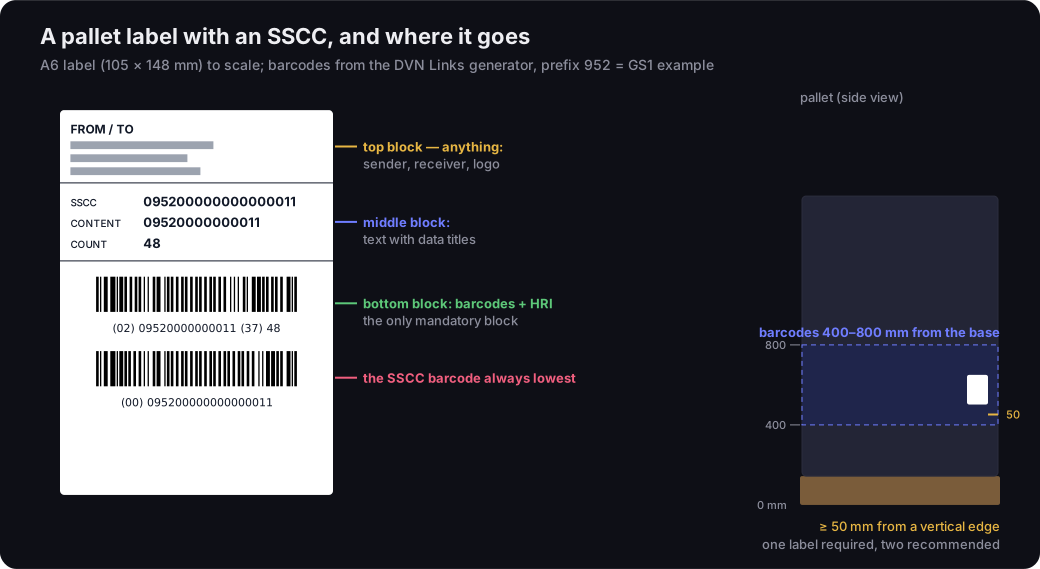
A GS1 logistic label has three blocks, but only the bottom one is mandatory: the GS1-128 barcode with the SSCC and the text beneath it. GS1: "The SSCC is the single mandatory element for all GS1 Logistic Labels", and on the blocks: "The bottom building block contains the barcode(s) including human readable interpretation (HRI). Only the bottom building block is mandatory" (GS1 General Specifications R26.0, §6.6.3).
- Top block — free format: sender, receiver, logo, handling instructions. Text at least 3 mm high (ibid., §6.6.4.4).
- Middle block — human-readable text with data titles instead of AIs: "SSCC", "CONTENT" (GTIN of the goods inside), "COUNT" (number of items), "BATCH/LOT". The data content should be at least 7 mm high; titles in English unless the trading partners agreed another language (ibid., §6.6.4.2).
- Bottom block — the GS1-128 barcodes, each with its HRI. The SSCC barcode "SHALL be placed in the lowest portion of the label", with the bars upright relative to the base of the pallet — what GS1 calls "picket fence" orientation (ibid., §6.6.4.1).
A label can also have segments — groups of data known at different moments. From the top, the usual order is carrier, customer, supplier (ibid., §6.6.3.2).
A pallet label with an SSCC, and where it goes
A6 label to scale; barcodes from the DVN Links generator, prefix 952 = GS1 example
Source: GS1 General Specifications R26.0, §6.6.3–6.6.4, §6.7.1 and §6.7.2; barcodes — DVN Links generator, 21 Oct 2026
Figure description
On the left, a mock-up of an A6 label, 105 by 148 mm. Top block: from and to, any content. Middle block: text with data titles — SSCC 095200000000000011, CONTENT 09520000000011, COUNT 48. Bottom block, the only mandatory one: two GS1-128 barcodes from the generator with text under each; the upper one (02) 09520000000011 (37) 48, the lowest one (00) 095200000000000011 — the SSCC barcode always at the bottom. On the right, a pallet seen from the side: a band from 400 to 800 mm above the base where the barcodes must be, the label at least 50 mm from a vertical edge; one label required, two recommended.
Size. GS1 does not fix label dimensions, but it names the formats that cover most needs: A6 (105 × 148 mm) or 4 × 6 inches — "particularly suitable when only the SSCC, or the SSCC and limited additional data, is encoded" — and, for more data, A5 (148 × 210 mm) or 6 × 8 inches (ibid., §6.6.4.5).
Position on the pallet. All barcodes on a pallet go "between 400 millimetres (16 inches) and 800 millimetres (32 inches) from the base of the pallet"; on pallets lower than 400 mm, as high as possible. The barcode including its quiet zones must be at least 50 mm from any vertical edge, so a forklift or the next pallet does not damage it (ibid., §6.7.1 and §6.7.1.1). Every unit needs at least one barcode (ibid., §6.7.1), and for pallets GS1 recommends two identical labels on adjacent sides — one on a short side, the other on the adjacent side to its right (ibid., §6.7.2).
A 2D barcode on the label. GS1 allows a GS1 DataMatrix or GS1 QR Code on a logistic label — as an addition carrying the same data as the GS1-128: "A GS1 DataMatrix or GS1 QR Code symbol MAY be included in addition to the GS1-128 symbol" (ibid., §2.2.1). A 2D barcode on its own is allowed only on a unit too small to take an A6 or 4 × 6 inch label. 2D barcodes at retail checkouts are the subject of our Sunrise 2027 article. The GS1-128 symbology itself — FNC1, Application Identifiers, the length limit — is covered in EAN 128 (GS1-128) vs Code 128.
SSCC barcode from the generator: measured on an A6 label
A GS1-128 barcode carrying only an SSCC from our generator is 87.12 mm wide and fits an A6 or 4 × 6 inch label with room to spare. We measured the file for (00)095200000000000011 — GS1 Prefix 952 is reserved for demonstrations and examples (GS1 General Specifications R26.0, §1.2.3). Decoding the bars gave 14 symbol characters: Start C, FNC1, ten digit pairs (AI 00 and the 18 digits of the number), the check character and Stop. That is 156 modules of bars plus 2 × 10 modules of quiet zone: 176 modules.
The generator draws GS1-128 at the GS1 dimensions for logistic units: X-dimension 0.495 mm (both the minimum and the target), 31.75 mm bars, 10-module quiet zones (ibid., Table 5-51). Hence the width: 176 × 0.495 = 87.12 mm; the file is 38.12 mm high.
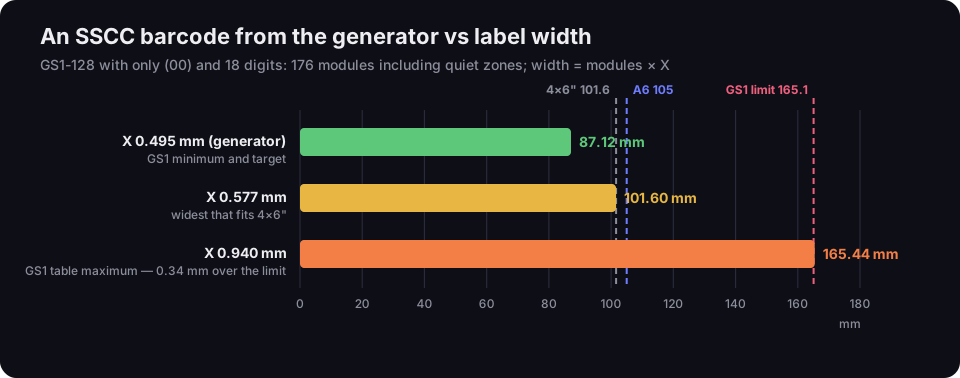
An SSCC barcode from the generator vs label width
GS1-128 with only (00) and 18 digits: 176 modules including quiet zones
Source: our measurement of a DVN Links generator file, 21 Oct 2026; X-dimension and limit — GS1 General Specifications R26.0, Table 5-51 and §5.4.4.3
Figure description
Bar chart of the width of a GS1-128 barcode carrying only an SSCC at different X-dimensions, with lines for a 4 by 6 inch label at 101.6 mm, A6 at 105 mm and the GS1 limit at 165.1 mm. X 0.495 mm, as in the generator, the GS1 minimum and target: 87.12 mm. X 0.577 mm, the widest that fits 4 by 6 inches: 101.6 mm. X 0.940 mm, the GS1 table maximum: 165.44 mm, 0.34 mm over the symbol length limit.
What this means:
- On A6 there is 17.88 mm to spare, on 4 × 6 inches 14.48 mm — roughly 7–9 mm of margin on each side (our calculation). Do not trim the quiet zones: they are in the file and they are part of the barcode.
- A larger module will not fit the width. The widest X that fits across an A6 label is 0.597 mm, across 4 × 6 inches 0.577 mm. The GS1 table allows up to 0.940 mm, but with just an SSCC that barcode would be 165.44 mm — more than the 165.10 mm GS1-128 symbol length limit (ibid., §5.4.4.3). The generator sticks to 0.495 mm, and there is no reason to change it.
- A second barcode fits too. The contained GTIN plus count,
(02)09520000000011(37)48, is also 87.12 mm in the generator, so two barcodes stacked one above the other fit the bottom block of an A6 label, as in the mock-up above.
How to make it in the generator:
- Open the barcode generator and pick the GS1-128 type (the generator opens on EAN-13 by default).
- Type
(00)and the 18 digits of the SSCC, with no spaces. To add the GTIN of the contents and the count, put them in a second barcode:(02)…(37)…. GS1 does not allow (02) next to (01) on the same unit (ibid., Table 4-4). - Download the file. PNG is free, with no account. SVG and PDF for print come with the Starter plan. Which file to hand to a printer or drop into label software is compared in SVG, PDF or PNG.
- Many pallets at once — from the Pro plan, bulk mode takes up to 100 numbers, one per line, and returns one PDF with a barcode per page or a ZIP of SVG files. Every line is checked before drawing; if even one number has a wrong check digit, the generator produces no file and lists the bad lines instead. Plans and prices (net, + VAT) are on the pricing page.
The limits: the generator does not assign SSCCs, keeps no counter and does not remember which numbers you have used. Nor does it build the label — text, blocks, several barcodes on one sheet. It draws a correct barcode from the number you bring. GS1 Poland says plainly that to produce a full logistic label you will "probably need special software" (GS1 Poland, GS1 logistic label, read 21 Oct 2026, our translation). Our SVG or PDF goes into that software or into your label template.
SSCC in the despatch advice (EDI) and at the receiver
The number on the label must be the same number you sent the receiver in the despatch advice — otherwise scanning the pallet tells them nothing. That is the SSCC's job as a key: it "provides a link between the physical logistic unit and information pertaining to the logistic unit that is communicated between trading partners using Electronic Data Interchange (EDI)" (GS1 General Specifications R26.0, §2.2.1). The despatch advice (an EDI message listing the pallets and their contents) reaches the receiver ahead of the goods; at the dock, one scan matches the pallet to the order.
Large receivers — retail chains, distribution centres, marketplaces — have their own label requirements: which data besides the SSCC, how many labels, where. GS1 Poland advises agreeing with the receiver what data the label should carry, and publishes the guidelines of several Polish retail chains, including Auchan, Biedronka, MAKRO, Netto, NEUCA, Rossmann, Carrefour and Intermarché (ibid.). We do not summarise them, because each receiver has its own document — get your customer's guidelines before the first delivery. Marketplaces that run their own warehouses describe their requirements in their supplier documentation.
Frequently asked questions
An 18-digit number for one logistic unit — a pallet, an outer case, a parcel — unique worldwide. In a GS1-128 barcode it follows the identifier (00). A GTIN says what the product is; an SSCC says which pallet it is.
You build it yourself from your company's GS1 prefix: extension digit, prefix, your serial reference and the check digit. Your GS1 member organisation issues the prefix when you join, not a number for each pallet. If you already have a GS1 Company Prefix for your GTINs, you can use it for SSCCs too; a single GTIN licensed on its own does not come with one.
A GS1 logistic label does — the SSCC is its only mandatory element. A warehouse label used only inside your company does not, but if the pallet goes to a retail chain or a distribution centre, the receiver may require a GS1 label with an SSCC — check their guidelines before the first delivery.
A GTIN identifies a kind of product — every unit of the same item has the same number. An SSCC identifies one specific logistic unit — every pallet has a different one. A single-product pallet can carry both, but a GTIN never replaces the SSCC.
Always 18. With the (00) identifier in the barcode and in the text under it, you see 20 digits — if you come across an "SSCC with 20 digits", someone counted the AI. Store 18 digits in your system and in the despatch advice.
Have an SSCC? Type (00) and the 18 digits into the barcode generator — it checks the check digit and draws a GS1-128 at GS1 dimensions. For a run of pallets, bulk mode comes with the Pro plan (pricing).